

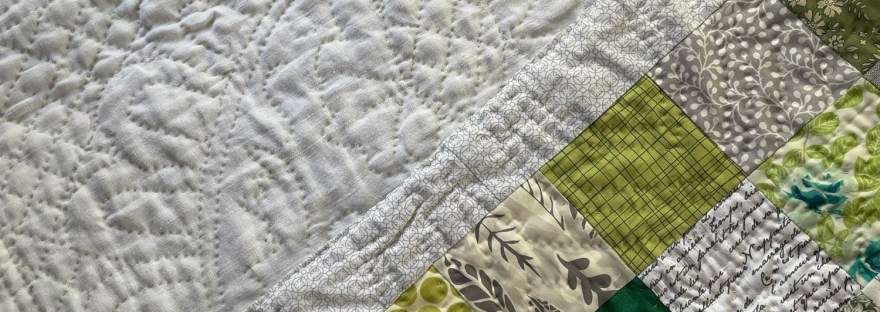
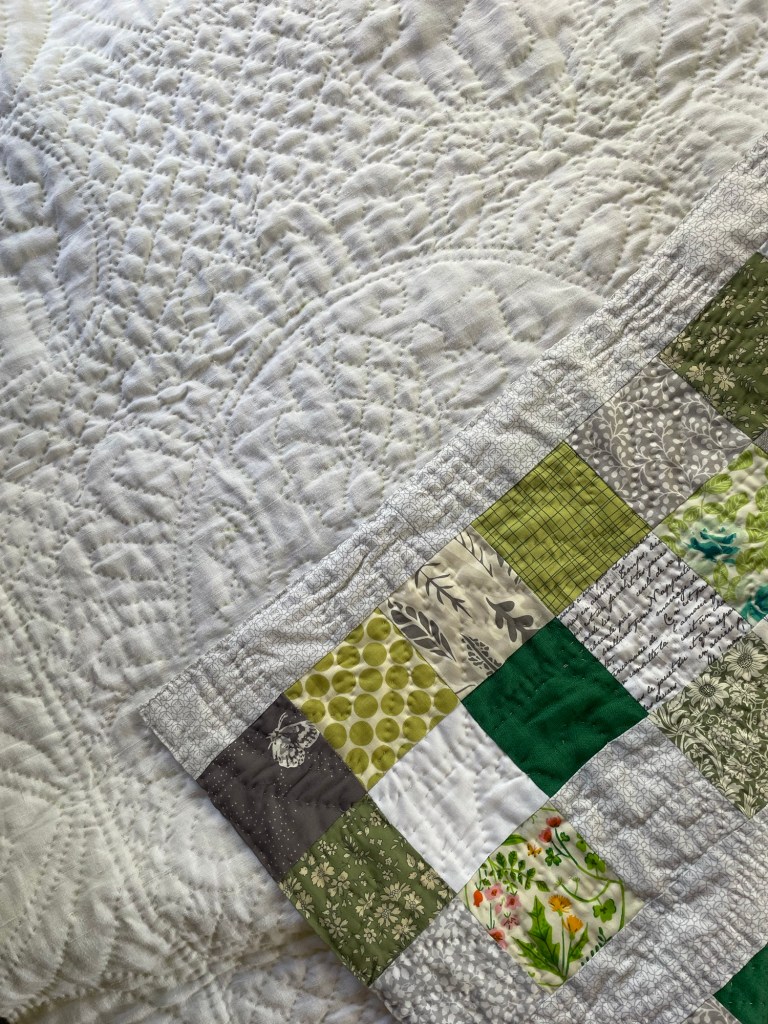
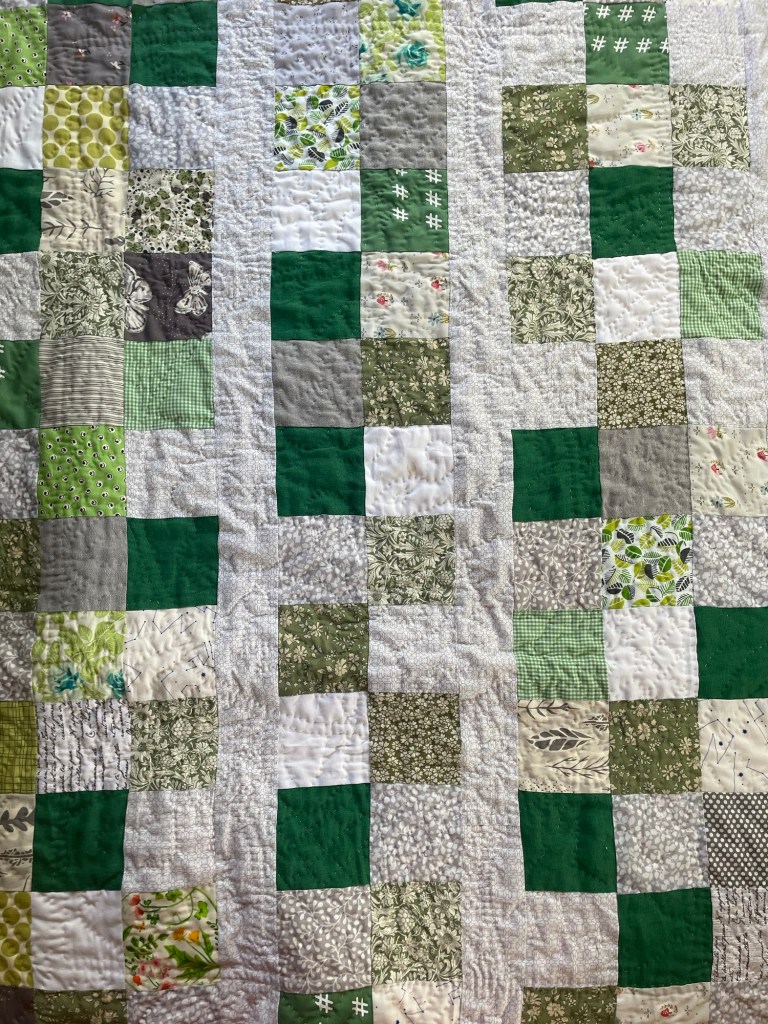
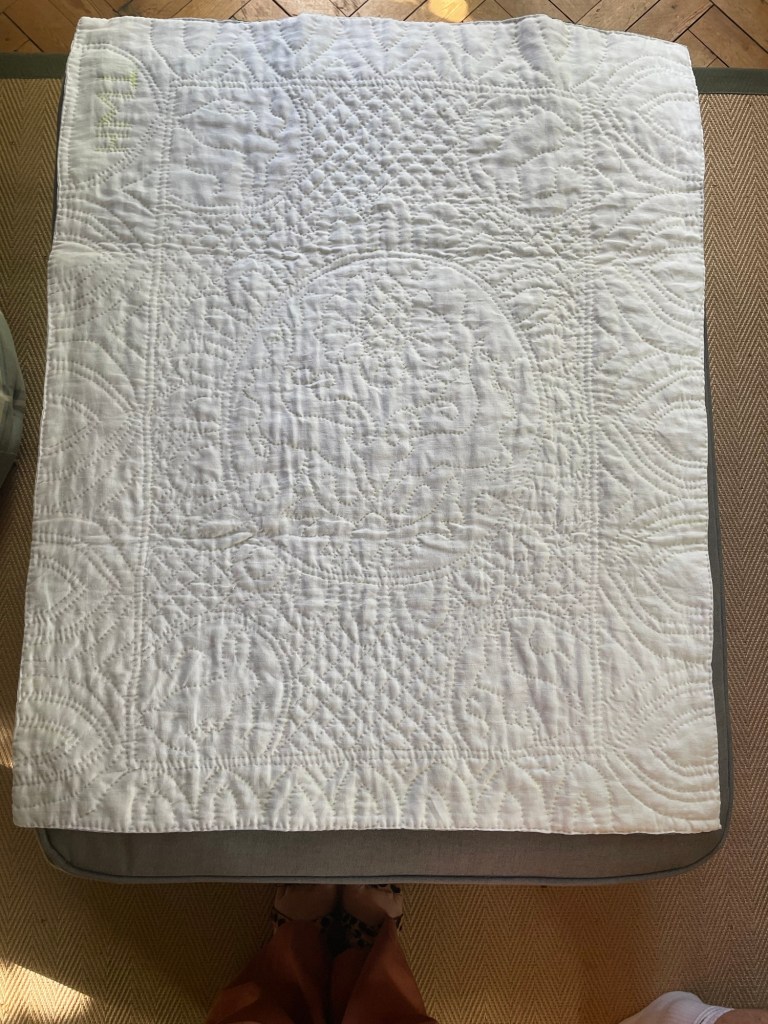
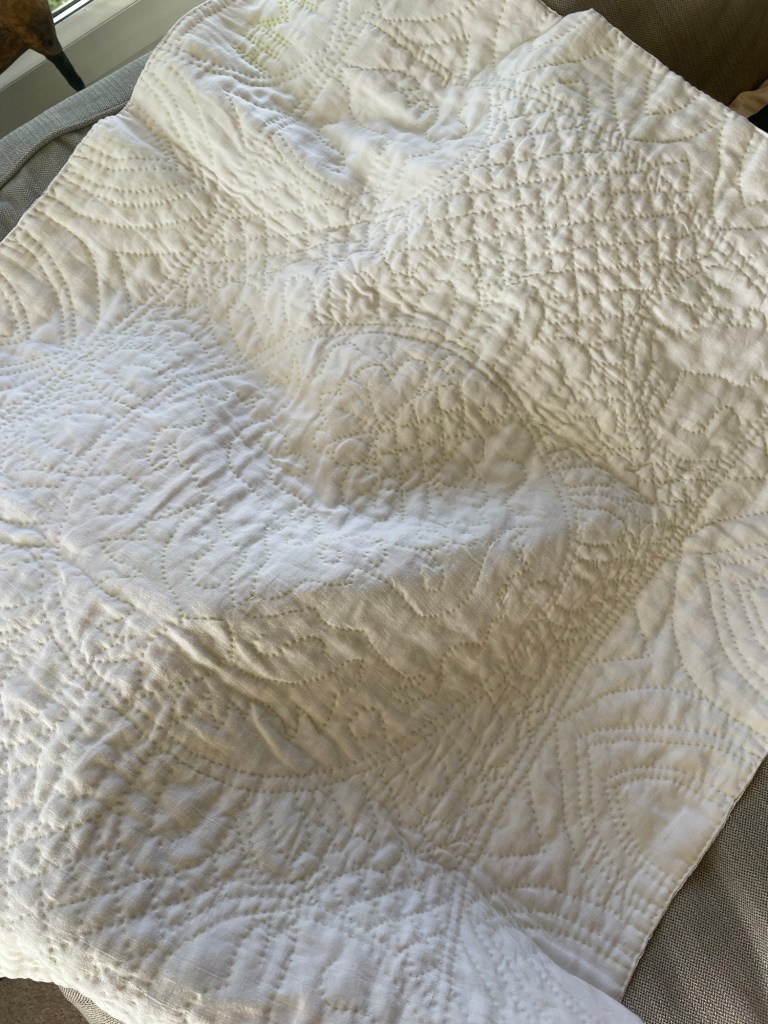
I just finished stitching a little cot quilt for a friend and colleague’s baby. It’s been a few years since I stitched for a baby and the experience had me nostalgic and reflecting. My friend is a historian of eighteenth century relationships, and so I knew straightaway that I wanted this quilt to reference Georgian quilts. Yet at the same time, I needed to make a modern fresh quilt for a new little babe in the world. I’ve enjoyed writing this blog post to share with you all this quilt; but also to share how baby quilts looked in the past and to think about what they meant. It was such a fun brief to sew and write this project up, I’ve loved travelling space and time making it.
You see, there is something profoundly moving about making a cover for a newborn baby. I made some of my first quilts in this period of my life and so many others recite this as a pivotal impulse in their making experiences, whether for their own child or the child of a friend or family member. Based on the proliferation and variety of baby quilts in British collections this is a phase of life that obviously also generated flurries of making in the past. For this post I wanted to share some of the making of this little quilt, whilst giving you a taste of the long history and wide range and variety of historical baby quilts in Britain and their changing, but continuing role as a form of emotional communication through time.
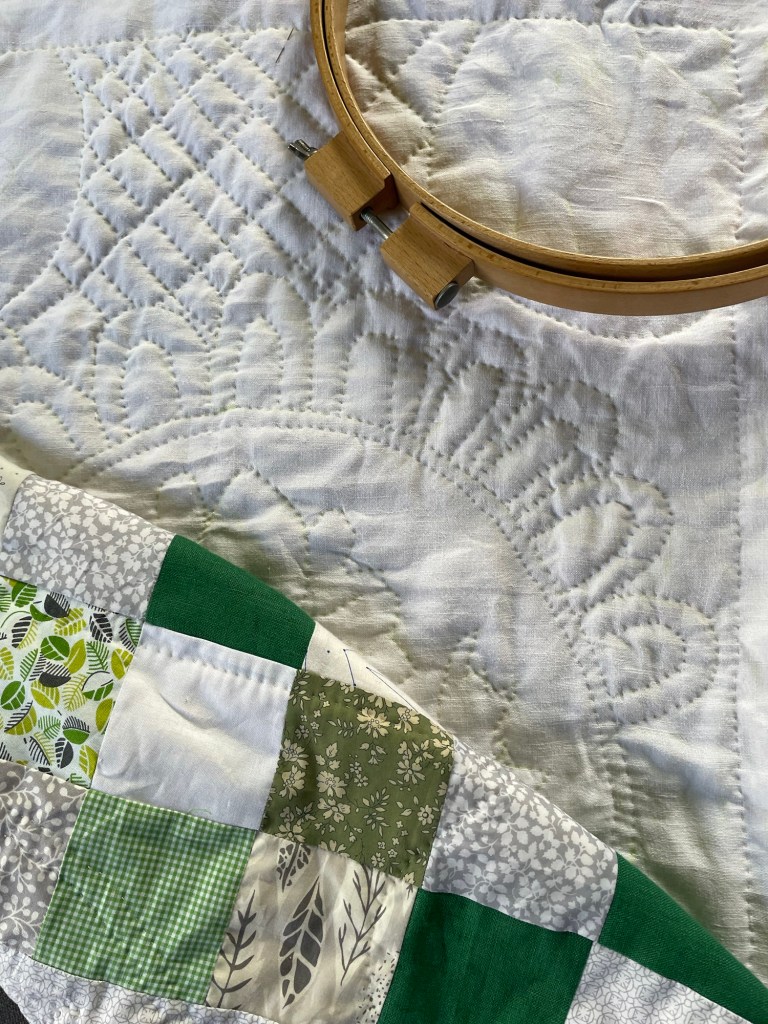
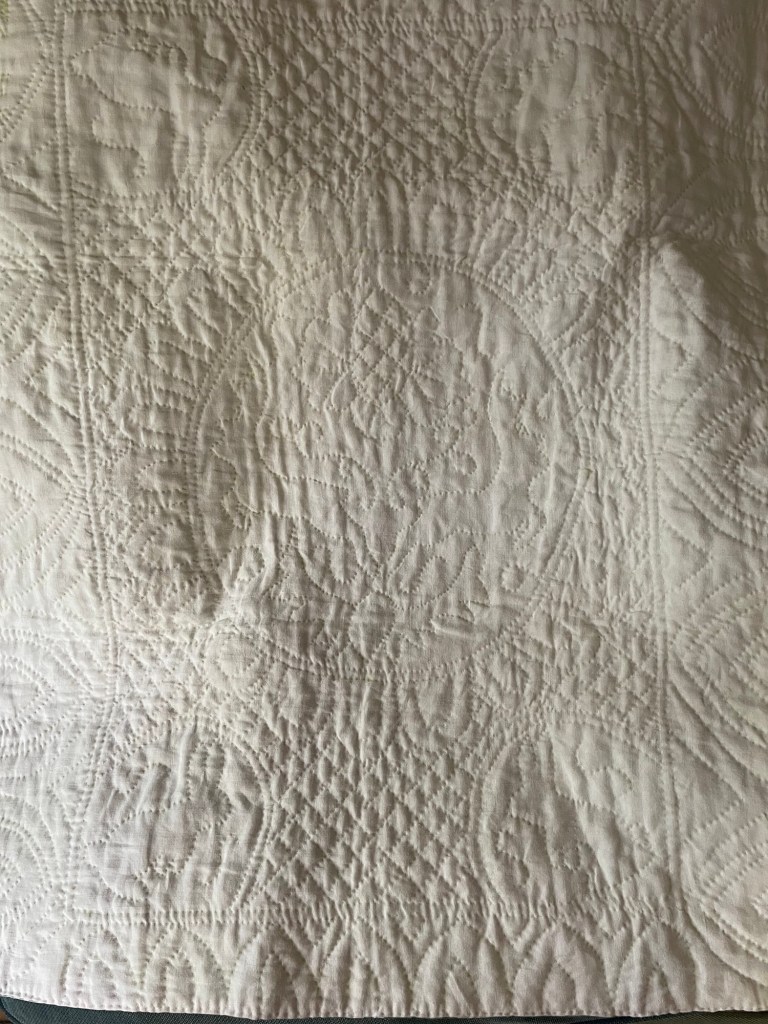
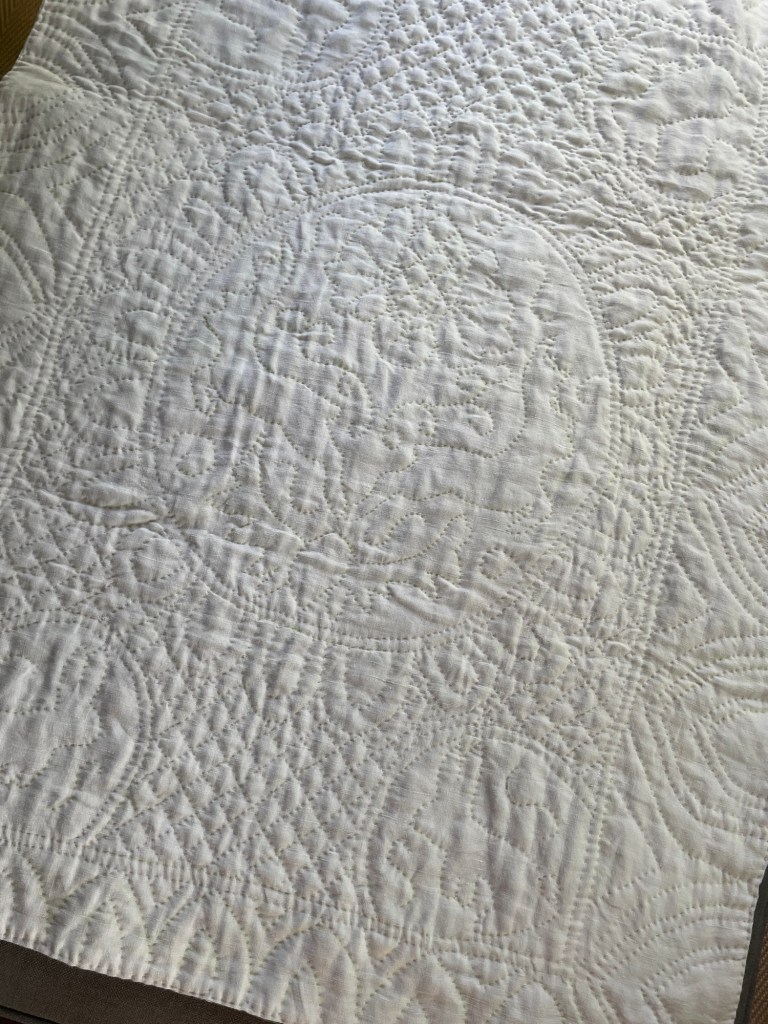
For my quilt I had a delightful little swatch of ideas for the new baby from his mum, which included a fresh natural palette and a love of the rural outdoors. I decided to draw on two historical quilts from the Georgian era that I had encountered in my studies, a wholecloth and a patchwork. For the wholecloth side I wanted to use linen, the most common early Georgian quilt substrate after silk and I used a lovely piece of a soft but strong old linen tablecloth. Like later Georgian makers, for the back I went with a checkered patchwork to allow me to reflect a wide range of cottons with a natural feel, which meant all of my favourite modern Liberty prints, ginghams, and leaf prints could be included. Later Georgians adored patchwork to best show off the proliferation of printed cottons that were newly available in their era.
Baby quilts are some of the earliest extant versions that survive in British collections. Perhaps this is a quirk of their size, they are easy to store, and less likely to be deemed as taking up needed space and given away. Perhaps their only occasional use in the lifecycle meant that they were less worn. Or maybe, perhaps more likely, their preservation was emotional, kept as keepsakes, or talismans for generations to hold and use. Like all quilts, for baby quilts the demands of both use and sentiment overlap.
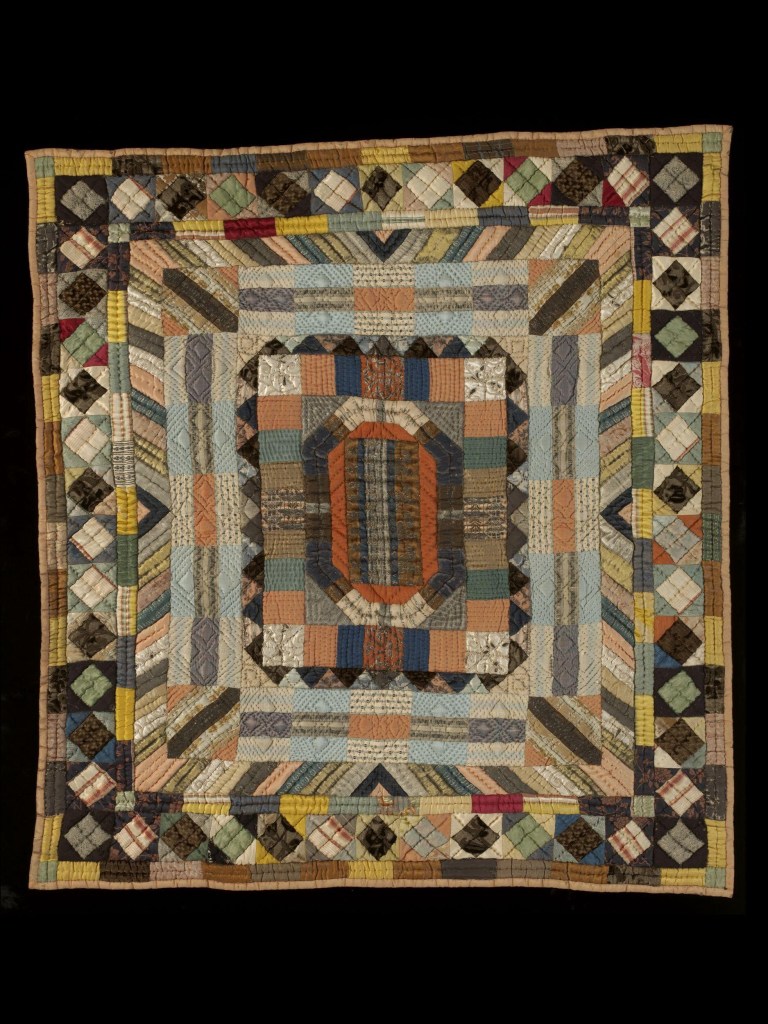
Perhaps the oldest extant baby quilt that we might recognise is this beautiful, early silk patchwork and quilted cover in the V&A, probably made by a member of the Redding family in Kent whose textiles included several quilts and a diary which outlines the ways that matrilineal bonds were reinforced through the making, giving and receiving of textile items like quilts. You can read more about the textiles of this family in the V&A Quilts 1700-1010 book from the 2010 London exhibition.
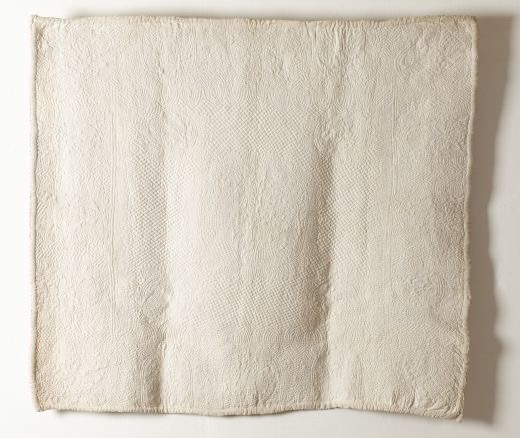
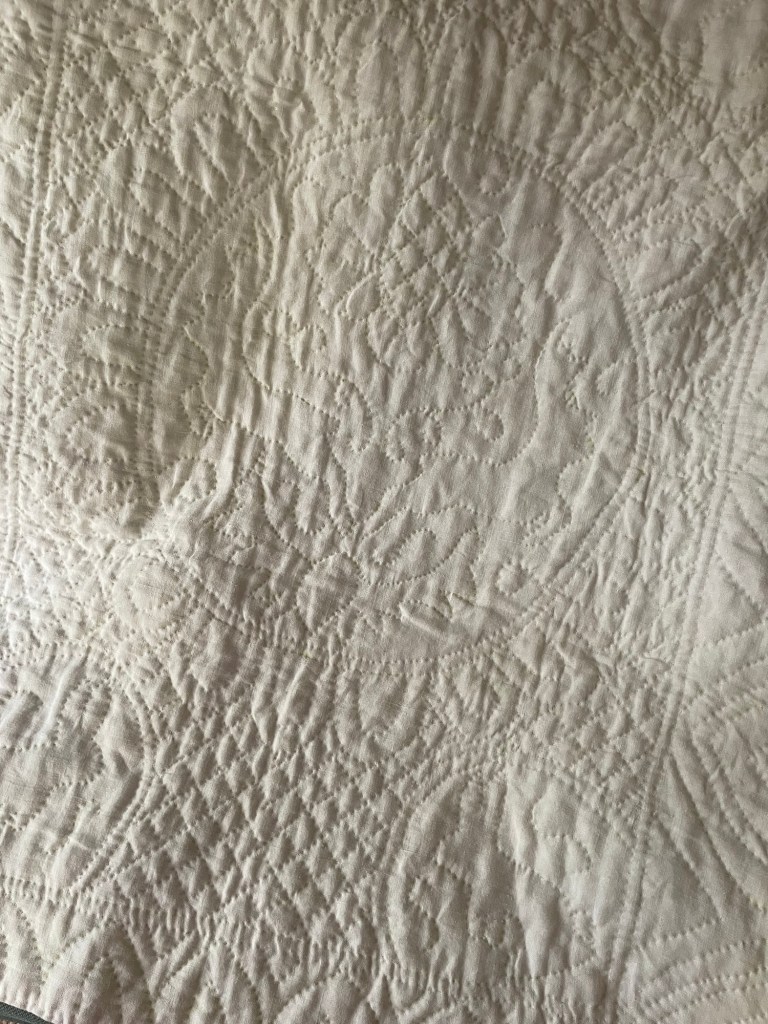
As a quilter more than a patchworker, I took my main inspiration, however from this beautiful wholecloth baby quilt in The Quilt Collection in York, made between 1700 and 1710. Made of linen and decorated in complex quilted patterns which include a central roundel and arched corners. The borders are made up of arches, each filled with a fantastical or mythical image. It was probably commissioned from one of the professional makers who worked in London at this time as some of the images are related to other extant quilts of this period. To read more about Georgian quilt making see this recent post.
Paintings also reveal to us the role of warm quilted bedcoverings for babies, such as the one by Hogarth below, of baby Hamilton in 1732, which demonstrate the preparations that elite women made in linen for the arrival of a new baby. Women’s letters account for the preparations and the anxiety that surrounded these arrangements. Whilst these quilts are small, typically around 1m x 1.20m, they all show significant amounts of work which would have taken some time to complete, even if a commercial commission. Often the quilt cover was just one part of a set of quilted items including a hood and curtains like in the picture below, or including quilted clothing for child and even a matching jacket or waistcoat (“body”) for the nursing mother. Yet this level of work required some certainty of how much gestational time was available for completion. Of course, in the past in a time before obstetric ultrasound, this certainty could often be elusive. It’s clear that the complexity and care lavished on these little textiles reaches beyond the utilitarian.
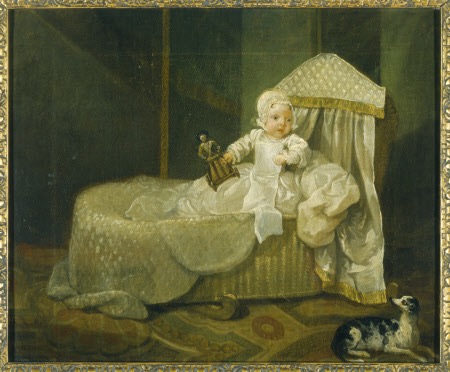
William Hogarth (London 1697 – London 1764), c.1732, Oil on Canvas, Upon House, Warks, NT 446679
All of these quilts record for us the careful preparation for a new child. When I talk at quilt groups about baby quilts in history I often hear the belief that babies were less cherished in times of high infant mortality. Whilst it is certainly true that attitudes towards infant mortality were different in the past, framed by religious ideas of divine providence and a secure afterlife and shaped by more frequent losses, there is little evidence that babies were less cherished, or that grief was less sharp and I explore these issues in my masters dissertation ‘Remember Me’, which looks at quilt making through the lifecycle. These baby quilts, in their complexity and in their long preservation speak to us of anticipation and commemoration. However, what is very true is that the conception of the unseen baby changed through time as medical knowledge and spiritual belief about the unborn child evolved.
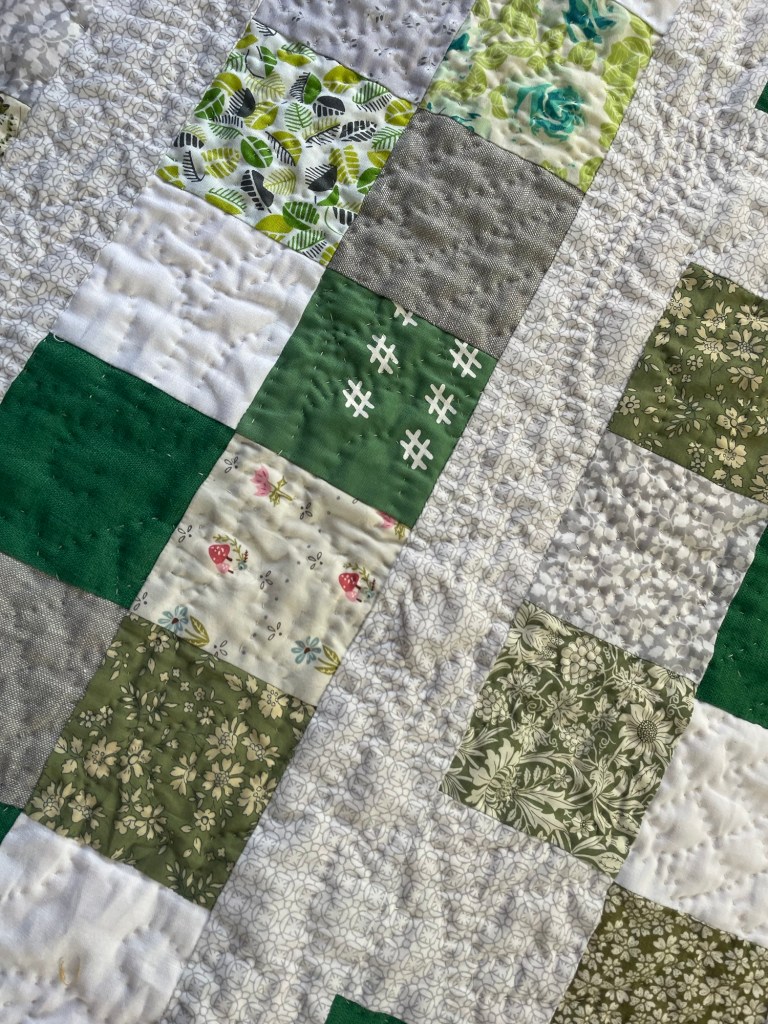
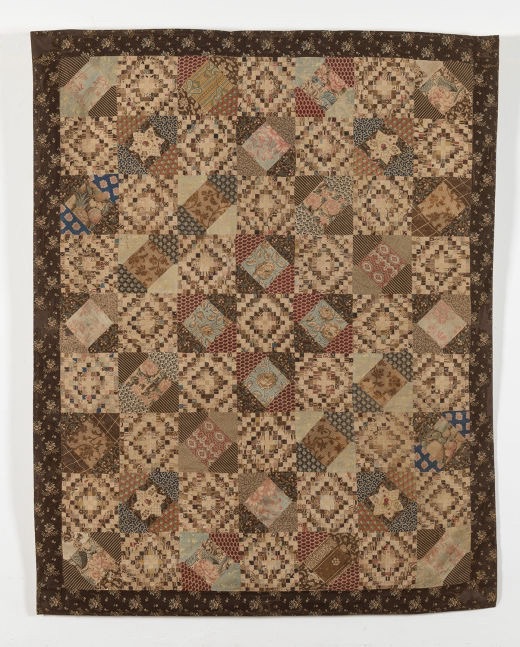
There is considerable evidence of apprehension at the approach of childbirth, and given the relative lack of insight into the medical process of pregnancy (and even with it), this is unsurprising. Uncertainty was the given, in anticipation and timings as well as in outcome. Only maternal size, and prior experience was an accurate measure of the impending birth. The stethoscope was not routinely used until the 1880s to listen to heartbeats, ultrasound not routine until the 1970s – in the past only maternal senses, and the insights of a strong and experienced matriarchal network revealed the state of the child or the gestation of the pregnancy. The piecing of complex patchwork, like the quilt below, or complicated hand quilting offered a practice which might sooth and distract whilst filling and measuring the time as a birth approached. Busy mothers with large families and physically demanding household and paid work, both then as now, likely had little time for contemplation necessary to accurately determine or document when a baby might be imminent. For first time mothers, the experiential and community knowledge of friends and family was key.
Gifts such as quilts did emotional work in the past and today, they offered reassurance through the rituals of preparation, their commissioning and making drew experienced family members around the expectant mother. Planning made the invisible baby more real, anyone who has awaited the birth of a child can attest to the sense of unreality that has not been irradiated with the science of the 3D scan. Making birth preparations brings families and friends together, and forms a kind of unspoken sense of solidarity to support and encourage the impending labourer. The webs of letters which connected female friends and family in the preparation of these textiles for birth mean that we can see these relationships in historical sources. Baby quilts are a remaining tangible manifestation of these concerns and the emotional networks that assuaged them.
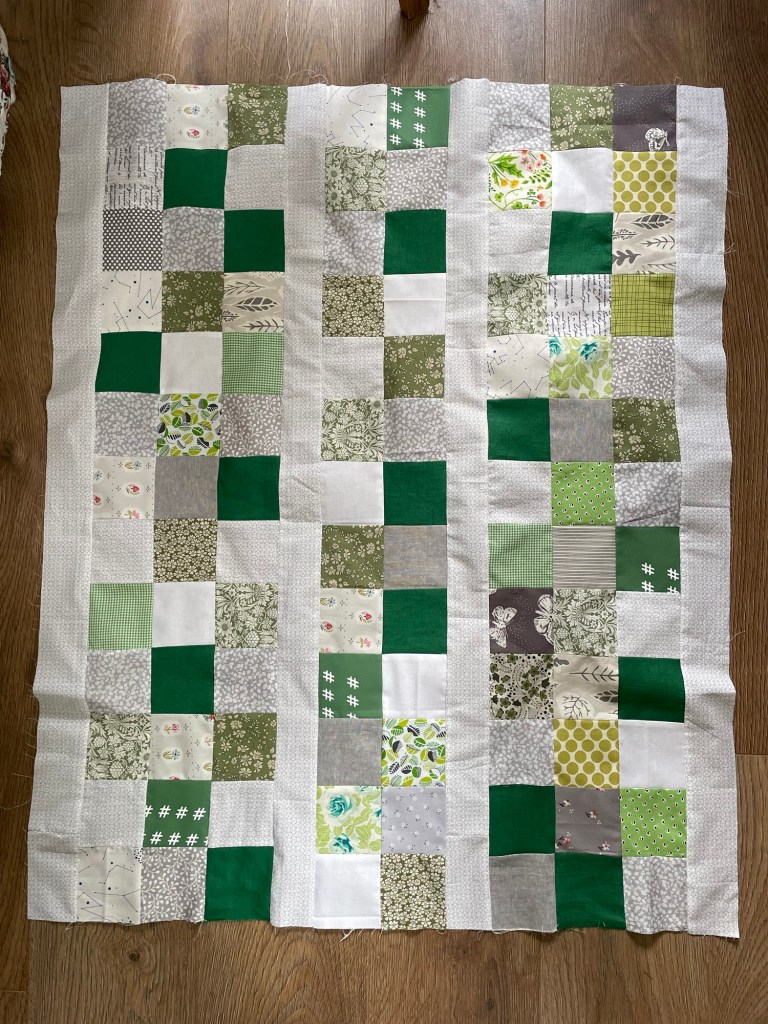
Transforming pieced patchwork into the textural finish of a quilted cover is a kind of alchemy, which bears comparison to the slow passing of pregnancy. Whilst the first small stitches seem to make no alteration, as time passes and stitches imperceptibly grow, the flat patchwork grows its own texture and bulk. As I hand stitched this little hand quilt, I loved the transformation of the texture of this quilt, with soft worn linen on the other side. Whist the worlds that we stitch within are changed beyond recognition, the soft rhythms of stitch, just like the anxieties of anticipation and the eventual pains of labour, remain largely unchanged.
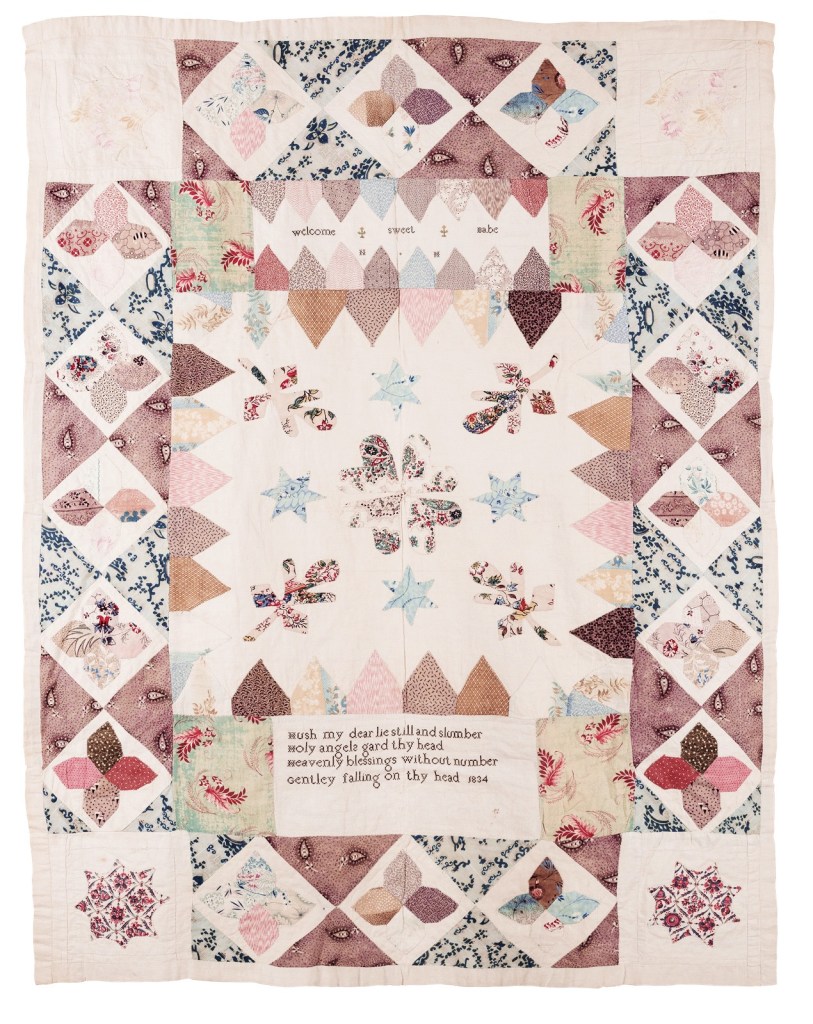
Mothers like Nancy Horsfall in the 1830s treated their quilt making as a kind of family album or chronicle. She first pieced a quilt for her marriage and then the next year, from the same scraps, pieced a little quilt for her ‘sweet babe’ as she embroidered into the quilt. It is difficult not to read a kind of tender preparation into textiles such as this. Nancy embroidered a lullaby, expressing maternal anxiety for the safety and security of her small child whilst recognising the power of heavenly providence in keeping a child safe. If the worst happened, and all did not work out well, a quilt or sampler formed sometimes the only material evidence of a short life.
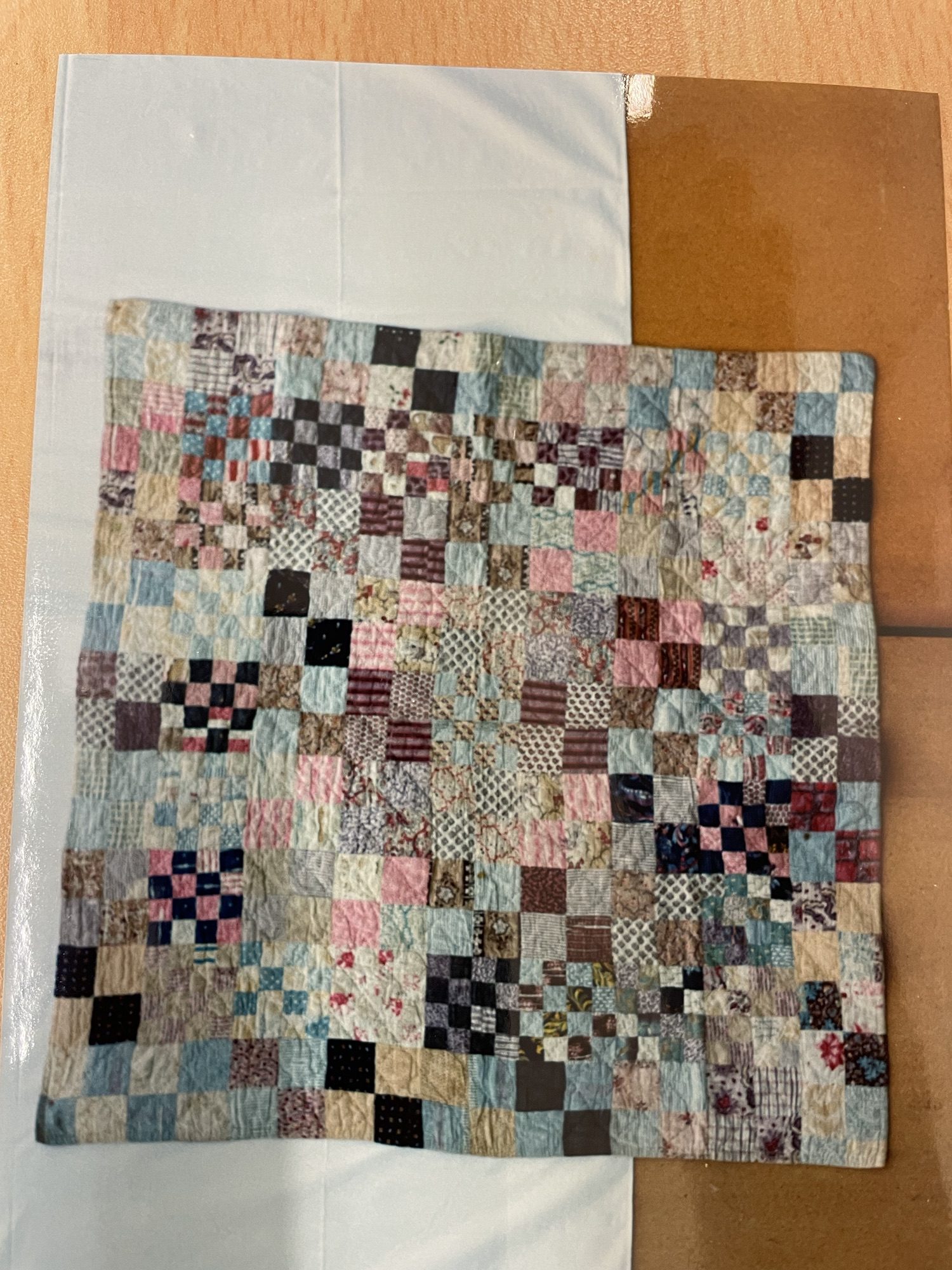
In most families this quilt making was communal. The Cann family, a widowed mother Mary Dennis Cann and her six adult daughters made many quilts in Devon through the 19th century, The Quilt Collection in York now holds several which include two small crib sized quilts made for the only grandchild of this matriarch. These quilts are classic scrap quilts, the fabrics probably reflective of the scraps of an intensely female household making clothes and quilts together. Whilst these quilts are utilitarian, their careful quilting and tiny squares speak also to the attention lavished on this kind of devotional making.
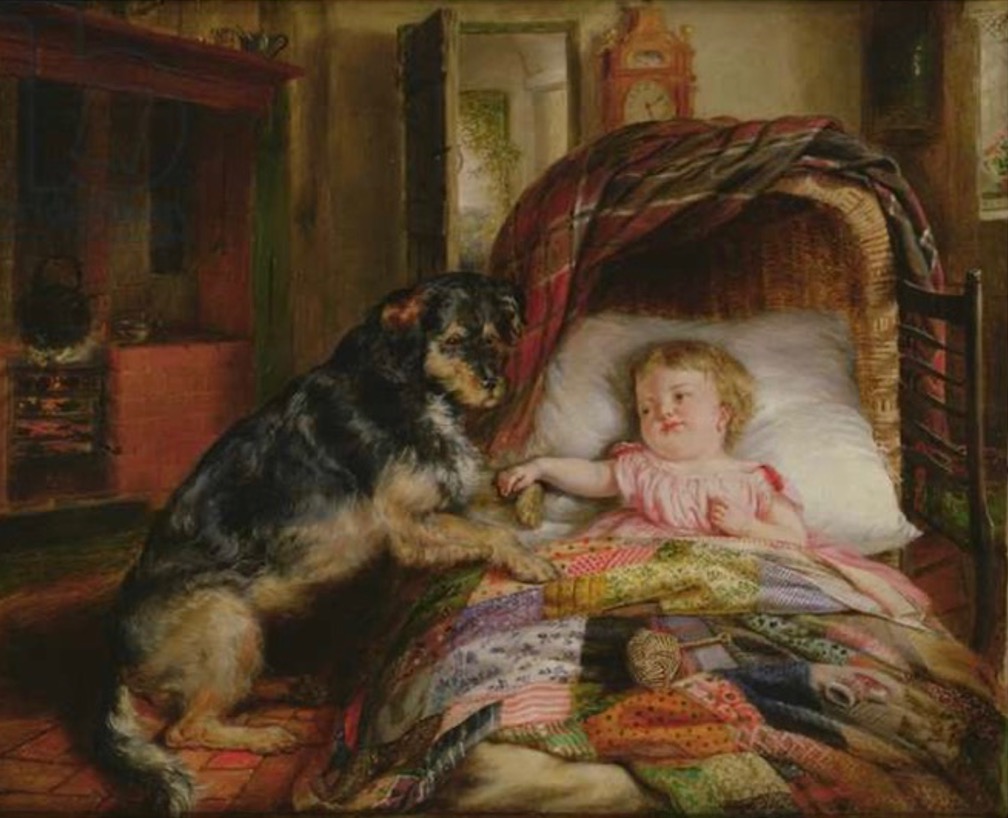
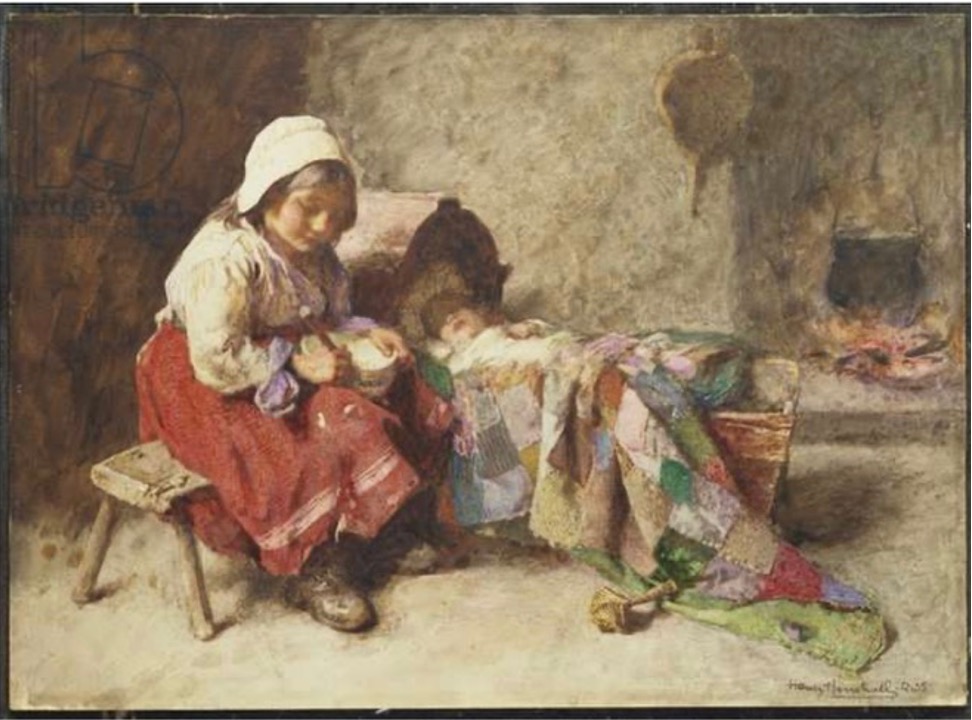
Paintings from the Victorian period also attest to the frequent use of patchwork as an appropriate baby cover. Their association with safety and care are clear in paintings such as this one where dog ( an/or quilt?) guards baby from harm.
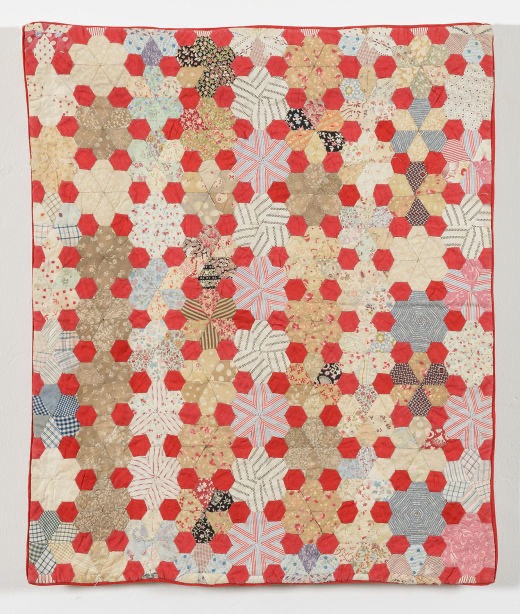
But this is not a distant tradition, by the end of the nineteenth-century the range and variety of cotton fabrics were reflected in baby quilts like this pretty little hexagon quilt. Society’s feelings about children had undergone a profound change; by the end of the nineteenth century there were laws to protect children and their schooling was compulsory. Family size was falling as urban planning, sanitation and healthcare worked to keep small babies safer and as women’s emancipation grew. Whilst the experience of babies in the homes of the rich and poor remained profoundly different, the range and style of extant quilts that have survived made for babies in this period demonstrates that many across the social scale could expect to sleep under a handmade quilt.
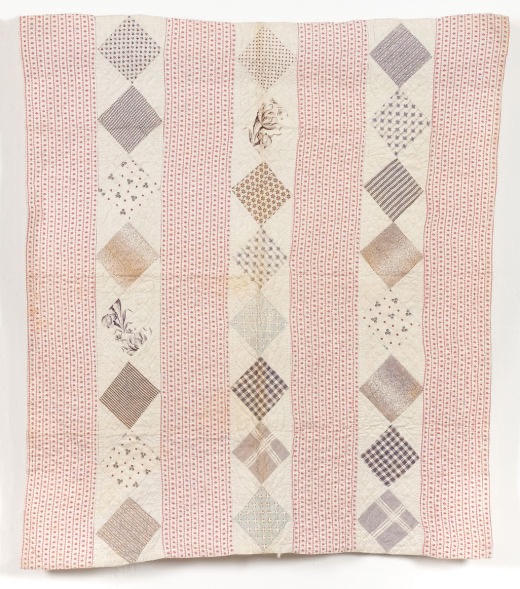
Areas of the UK whose quilting traditions were most protected from the sweeping changes of Victorian Britain kept their cultural heritage alive and vibrant through the making of quilts with regional designs, like this little strippy quilt, most probably made in the upland areas of Northern Britain. Its simple cotton prints and utilitarian strippy design reflected the kinds of quilts most commonly found on beds in working homes in this region at this period. You can read more about the makers of this region in my paper for quilt studies on the Quilt Stampers of Allendale.
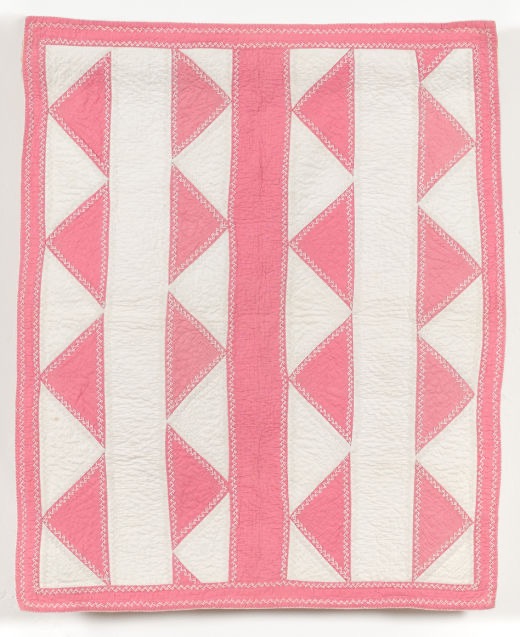
It is sometimes the case that these quilts, made in working homes are dismissed as purely utilitarian. Women using scraps to piece little covers which cost them only time. Yet the small size of baby quilts was so often enhanced with lots of careful stitching like the featherstitch edging of this simple patchwork for a crib from around 1900, that it is impossible not to read care in their making.
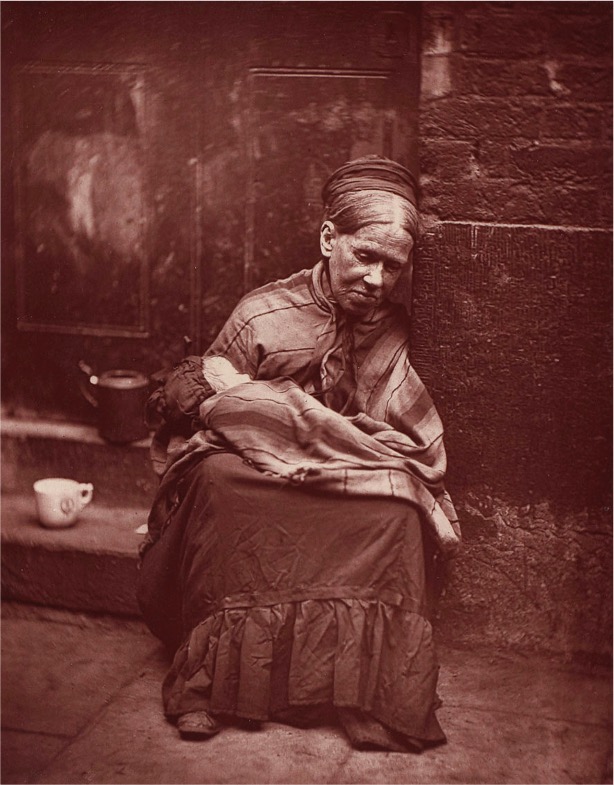
It is easy to fall into a sense of warm nostalgia as we look back at cherished baby textiles of the past. As historians we see clearly that the past was seldom as cosy as we are sometimes encouraged to believe it was in hindsight. Baby quilts are just as likely to appear in my studies in the records of illness, abandonment and infanticide. We should not forget that pregnancy and birth were (and for so many women, remain) the most vulnerable periods of their lives and this meant that their babies were also vulnerable. In studying the baby quilts of the past we also need to review those who appear as makeshift shrouds, threadbare pall covers and tragic tokens as babies died, were murdered or abandoned when the choices that society offered vulnerable women were intolerable. Yet in these stories the role of the baby quilt as a symbol of something more than just practical warmth is clear. Women draw on quilts as evidence of their care, as tangible proof that their baby was cherished and as tragic evidence that the baby was linked to them through shared textiles as a tragic thread.
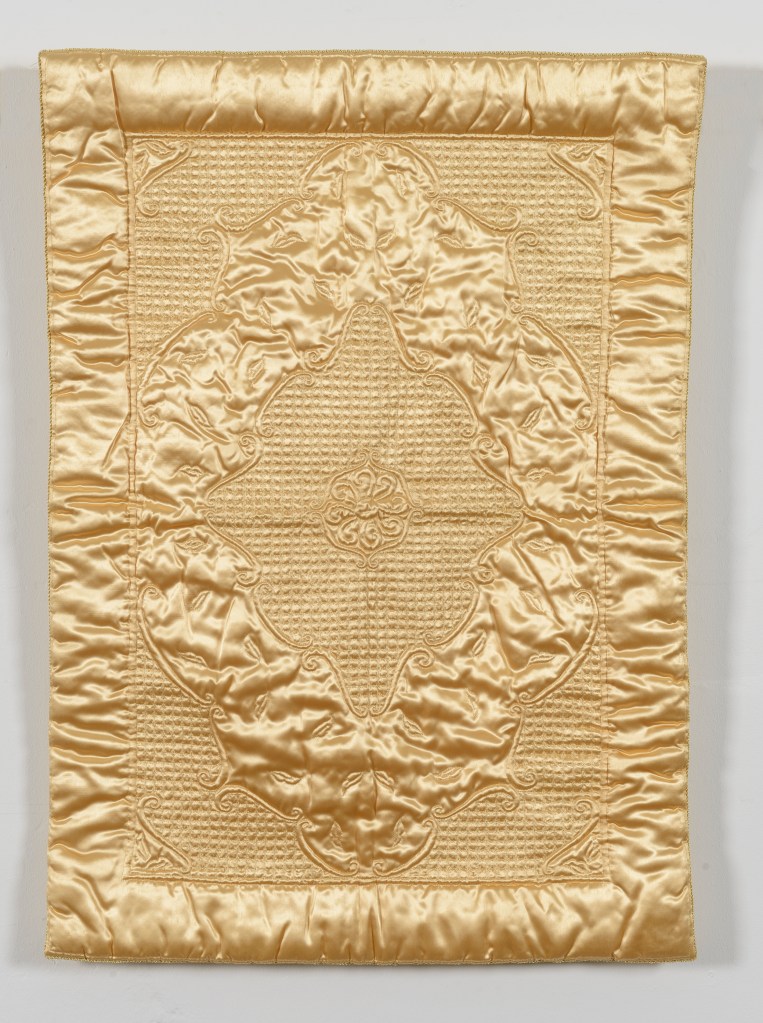
Whilst many of the traditions of quilt making waned in the face of the changes of the twentieth century, the form and style of baby quilts remained influenced by the past. This 1950s sateen rayon wholecloth recalls the silk wholecloth quilts of the eighteenth century. The hexagon patchwork from the 1960s below uses other modern synthetic textiles from 1960s dresses in a similar style to the bright silks and new cotton dyes of the end of the nineteenth century. Whilst we must take care not to equate these similarities to a direct belief that feelings are timeless. The physical process of gestating a baby lent itself to the timely preparation of objects of care in anticipation. Whilst the worlds that each of the babies who slept under these quilts were born into were changed beyond comparison to each other, the fact that someone anticipated these lucky babies arrival, and marked that anticipation in stitch endures for us to explore.
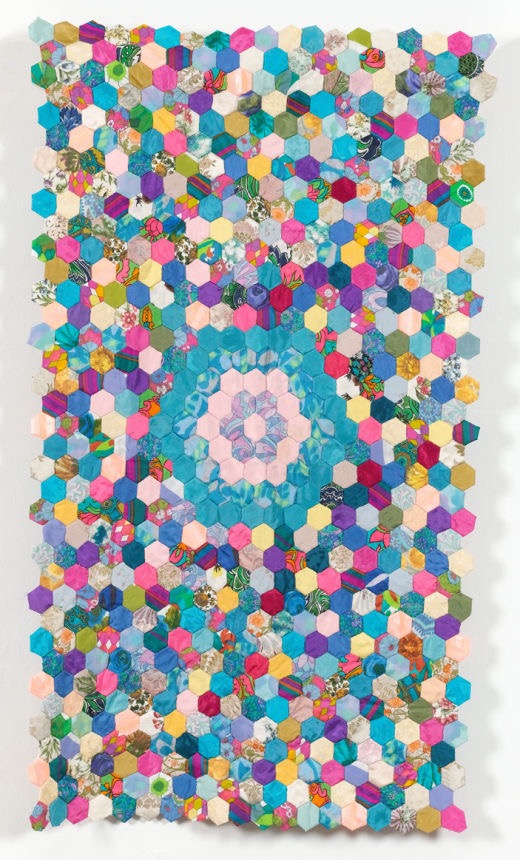
Hexagon patchwork cot top, made from dress fabrics. 1960 – 1969. The Quilt Collection, York.
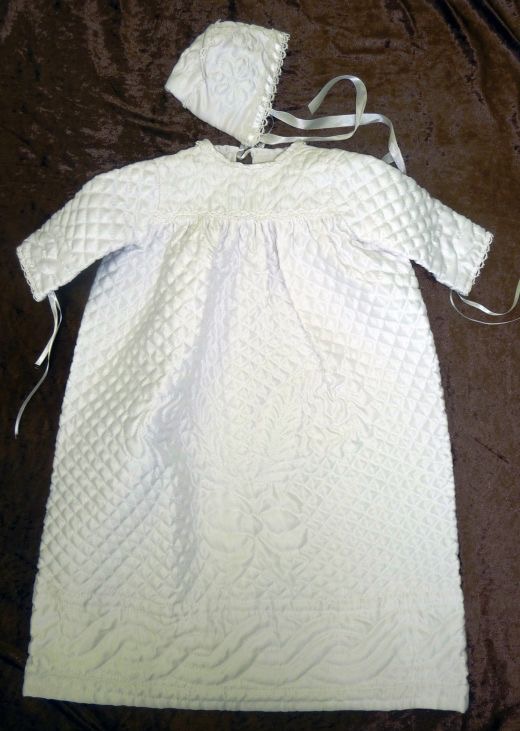
I hope that this little whirlwind post gives you a sense of the long history of this practice. But rather than just looking back I hope that it also encourages modern makers to think about how the past can inform new ideas. In the 1980s Eva Davies stitched this quilted christening dress as a family heirloom, in just the same ways that the babies of the eighteenth century were attired. But instead of a direct copy of the regional styles of the past she stitched her own families history, incorporating welsh quilting designs into the north country ones to make a unique design. Every generation looks back and forges the future. Our rich quilting history in Britain is full of inspiration for modern makers to evolve and shape the future of their making. If you are sewing in anticipation of a baby amongst your friends and family network, know that you form the newest link in an old chain, and do explore this history as you stitch for this new little person whose generation will help shape all our futures.
Making this little quilt was such a rare pleasure. I so enjoyed merging the history of the past which we study as academics, with fabrics and designs which reflect the way that we live today. I wish the little owner of this quilt much comfort and connection through a textile which links us with the hopes and fears of the past, just as it comforts those who will make our futures.
Stitching a baby quilt is a a very little undertaking, but one with such weight….. and it was ever thus.
Further reading: Giving Birth in Eighteenth-Century England (New Historical Perspectives) by Sarah Fox .
‘Breeding’ a ‘little stranger’: managing uncertainty in pregnancy in later Georgian England by Joanne Begiato
 Deborah McGuire