

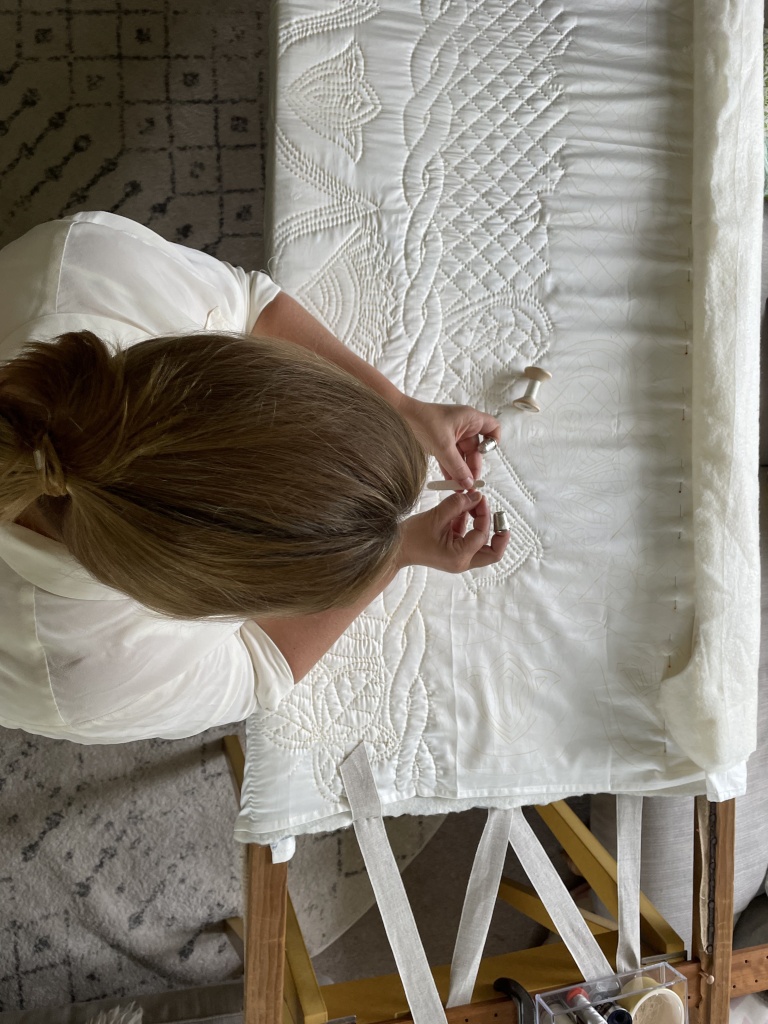
In response to the many messages I receive asking specific questions about using a flat frame, I am collating my responses here in the hope that they can help other curious makers interested in exploring this traditional method for quilt making today. If your question isn’t answered below do drop me an email and I will endeavour to help.
NB. I am a full time academic researcher, so sometimes it takes me a little while to get to all the messages I receive. Please bear with me.

How on earth do you get your quilt into the frame?
The quilt is loaded in layers. First the backing is either stitched to the woven tape on the two long bars of the frame, or pinned to it. The backing can then be wound onto the back roller. Then, if you are using commercial wadding you can lay this on the tensioned back and smooth flat – the rest will hang over the back. Then the quilt top is added and again stitched or pinned to the backing ( through the wadding) at the edge closest to the front bar. The top is then smoothed over the wadding. You can then either pin the top along the ‘back’ closest to the back bar, or I use a long wooden ruler which works as a weight to hold the top down. See the film I made here for more images of the frame and check out this post and this post for more images and discussion of this technique and its history.
Do you baste together the layers beforehand or can you use your frame to spread out the layers too?
You do not need to baste at all, the tensioned backing removes the danger of the back being uneven, and the top and wadding can be smoothed over this so it is clear that there is no moving or shifting.
The photos look like you are quilting from one end to the other – what are the advantages of that vs starting in the middle?
In the frame you need to start at one end and stitch to the other – it’s not really possible to begin in the middle, and is unnecessary.
How does the side tensioning work?
The side tensioning is necessary in a very large quilt, or in one where the backing is pieced. I use linen tape which I wrap over the side ’swords’ of the frame and pin to the backing to just hold the sides out flat. This is necessary because on large or pieced backs the middle of the quilt tends to wind tighter and therefore the edges can be a little baggy. Holding them tensioned keeps everything nice and flat and avoids the edges creeping in as you quilt.
Are you attaching the broad tape you can see in the photos to the backing? Does that damage the fabric at all? How much do you have to re-tension every time you move the quilt further?
Yes, the tape is pinned to the backing. It doesn’t impact the fabric, but even if it did it is pinned to the ‘waste’ edge of the backing which, as I use a knife edge binding, is tucked into the quilt when the edge is finished. If you have a particularly delicate fabric as your backing you can always baste a tape alongside the edge to pin into, a similar method is used in embroidery in a slate frame, but an important difference is that the tension you are looking for on a quilt frame is nothing like the tight tensions that an embroiderer would be looking to achieve – the fabric needs some give in the quilt frame so fabric is held less tightly and therefore damage is less likely to occur.
 Deborah McGuire